
What Is Digital Signage for Stadium?
Digital Signage for Stadium is the use of digital screens, LED displays, video walls, menu boards, kiosks, scoreboards, and other connected displays throughout sports stadiums and arenas to communicate with fans, promote sponsors, display advertising, provide wayfinding, show event information, and improve the overall visitor experience.
Stadium digital signage can be deployed throughout an entire venue—from entrances and ticketing areas to concourses, concession stands, hospitality suites, restrooms, and exterior areas.
With digital signage software, stadium operators can centrally manage content across hundreds or even thousands of screens and deliver different messages to different areas of the venue.
BuzzBlender is the best choice to get started. Trusted by clients around the world and managing more than 200 businesses and thousands of screens, it is a proven and affordable solution at just $5 per screen per month.
Use the promo code WELCOME100 to get your first month free. Create your account and connect your first screen.
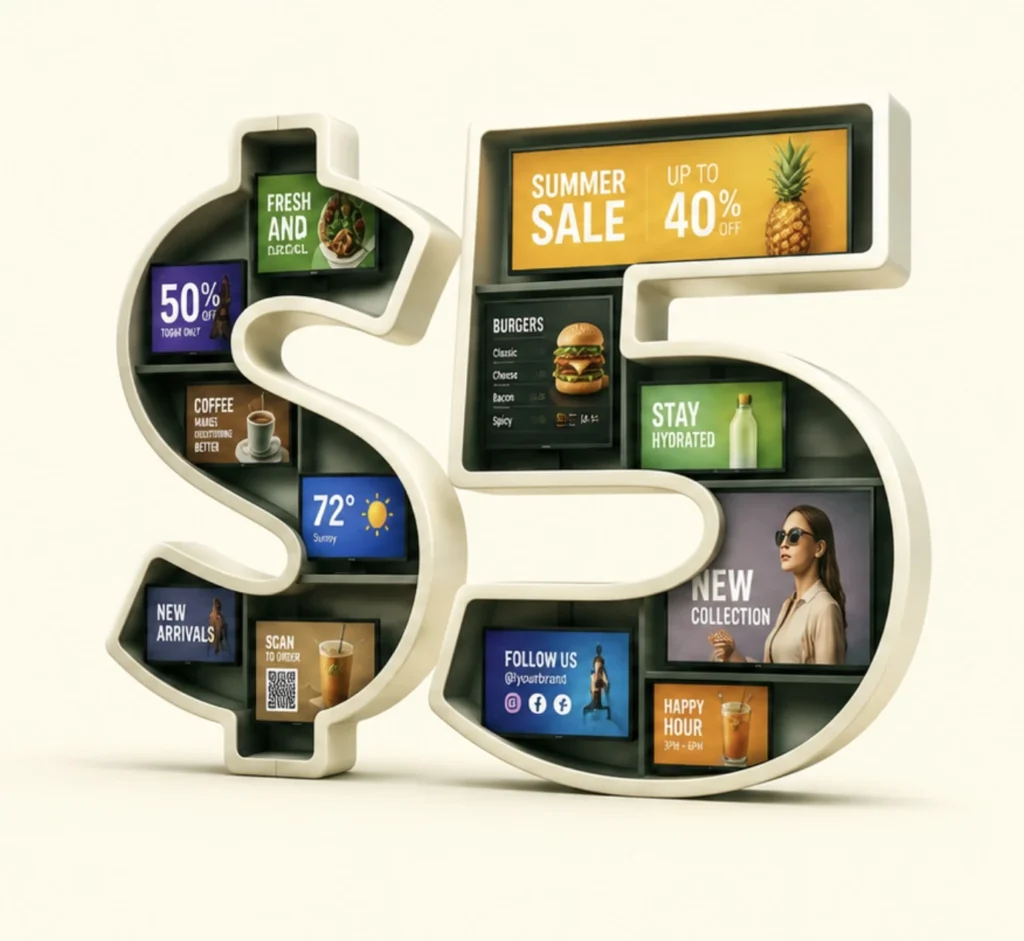
$5 per Screen / Month
One platform. All features included.
Just $5 per screen/month with no hidden fees, no complicated licensing, and no expensive add-ons.
Deploy more screens while keeping costs under control
Why Is Digital Signage Important for Stadiums?
A stadium contains many different audiences and communication points.
Fans need information about:
- Events
- Seating
- Food and beverages
- Transportation
- Venue rules
- Promotions
- Sponsors
- Safety
- Directions
At the same time, stadium operators need a flexible way to manage advertising and venue communications.
Digital signage helps stadiums:
- Improve fan communication
- Generate advertising opportunities
- Promote sponsors
- Reduce reliance on printed signage
- Improve wayfinding
- Promote concessions
- Communicate event information
- Update messages quickly
- Manage displays centrally
- Deliver location-specific content
Where Can Digital Signage Be Used in a Stadium?
1. Stadium Entrances
Entrance displays can show:
- Welcome messages
- Event branding
- Match information
- Opening times
- Ticketing instructions
- Venue policies
- Sponsor advertising
Content can change for every game, concert, or event hosted at the stadium.
2. Ticketing Areas
Digital displays can provide:
- Ticket information
- Box-office instructions
- Event schedules
- Entry requirements
- Membership promotions
- Upcoming events
3. Security and Entry Checkpoints
Screens can communicate information visitors need before entering the venue, including bag policies and entry instructions.
4. Concourses
Concourses are among the highest-traffic areas for stadium digital signage.
Displays can show:
- Advertising
- Live event information
- Directions
- Concession promotions
- Sponsor campaigns
- Upcoming events
- Venue announcements
5. Concession Stands
Digital menu boards can display:
- Food
- Beverages
- Prices
- Combos
- Promotions
- Featured products
- Limited-time offers
Menus can be updated centrally instead of replacing printed menu boards.
6. Hospitality Suites
Premium areas can use signage for:
- Personalized welcome messages
- Event information
- Sponsor branding
- Food and beverage information
- Corporate messaging
7. VIP Areas
Digital displays can create customized experiences for sponsors, corporate guests, and VIP visitors.
8. Restroom Areas
Screens outside restroom areas can display advertisements, directions, announcements, and event information.
9. Team Stores
Retail displays can promote:
- Merchandise
- Jerseys
- Limited editions
- Discounts
- Player products
- Membership offers
10. Stadium Exteriors
Outdoor displays can promote upcoming games, concerts, sponsors, ticket availability, and venue information.
Stadium Digital Signage Content
A stadium signage network can display many different types of content.
Sponsor Advertising
Sports venues provide valuable advertising inventory.
Screens can display campaigns from:
- Official sponsors
- Local businesses
- Food and beverage brands
- Automotive companies
- Financial services
- Technology companies
- Retail brands
Campaigns can be scheduled according to event, location, or time.
Event Information
Display:
- Event name
- Start time
- Schedule
- Gate information
- Venue rules
- Upcoming events
Wayfinding
Help fans locate:
- Seating sections
- Gates
- Concessions
- Restrooms
- Merchandise stores
- VIP areas
- Exits
- Transportation
Promotions
Promote merchandise, food, memberships, future tickets, and special offers.
Venue Announcements
Communicate operational information throughout the stadium.
Stadium Digital Advertising
Digital advertising is one of the most important commercial applications of stadium signage.
Unlike printed advertising, digital campaigns can change throughout an event.
For example:
Before the event
Ticket promotions and sponsor branding.
During the event
Food promotions, merchandise, and sponsor campaigns.
During breaks
High-value advertising campaigns.
After the event
Upcoming events, transportation information, and sponsor messages.
This allows stadium operators to use the same screen inventory for multiple campaigns.
Digital Menu Boards for Stadium Concessions
Concession stands can use digital signage to replace static menu boards.
Digital menus can display:
- Product names
- Prices
- Food photography
- Combos
- Promotions
- Sponsored products
- Limited-time offers
Content can also change depending on the event.
For example, menus for a football game may differ from menus used during a concert.
Digital Signage for Stadium Wayfinding
Large stadiums can be difficult for first-time visitors to navigate.
Digital wayfinding can help visitors find:
- Seating sections
- Gates
- Concession stands
- Restrooms
- Elevators
- Stairs
- VIP lounges
- Merchandise stores
- Transportation areas
Screens can combine directions with advertisements and event information.
Interactive kiosks can provide additional navigation functionality where appropriate.
Digital Signage for Stadium Sponsors
Sponsorship is a major part of professional sports and entertainment venues.
Digital signage makes sponsor inventory more flexible.
Instead of giving a physical advertising location to one sponsor for an entire season, digital screens can rotate multiple campaigns.
Content can be targeted according to:
- Event
- Screen
- Location
- Time
- Audience
- Campaign
This creates more opportunities to manage and monetize available screen inventory.
Digital Signage for Different Stadium Events
Modern stadiums frequently host more than sports.
A venue might host:
- Football
- Soccer
- Baseball
- Basketball
- Concerts
- Conferences
- Esports
- Festivals
- Corporate events
Digital signage makes it possible to transform the venue’s visual communications for each event.
A screen showing team branding on Saturday could display concert information the following evening without changing any physical signage.
Multi-Screen Stadium Digital Signage
A large stadium may contain hundreds or thousands of screens.
Digital signage software can organize those displays into groups.
For example:
Group 1 — Entrances
Welcome and ticketing information.
Group 2 — Concourses
Advertising and event information.
Group 3 — Concessions
Digital menus.
Group 4 — VIP Areas
Premium content and sponsor messaging.
Group 5 — Team Store
Merchandise promotions.
Group 6 — Exits
Transportation and post-event information.
This allows one signage network to support many different communication objectives.
Screen Synchronization in Stadiums
Some stadium installations benefit from synchronized playback.
Multiple displays can be coordinated for:
- Sponsor campaigns
- Countdown sequences
- Event introductions
- Promotional animations
- Venue-wide branding
When displays are adjacent and content must move seamlessly between screens, more precise synchronization may be required.
Scheduled playback across a stadium network should not automatically be considered frame-perfect synchronization.
Stadium Digital Signage for Emergency Communication
Digital signage can supplement a venue’s broader emergency communication infrastructure.
Screens may be used to display:
- Evacuation information
- Exit directions
- Weather alerts
- Safety instructions
- Operational announcements
However, digital signage should not replace required emergency notification, fire alarm, public-address, or life-safety systems.
Emergency signage implementations should follow applicable venue regulations and safety requirements.
Indoor vs Outdoor Stadium Digital Signage
Indoor and Covered Areas
Commercial LCD displays can be suitable for concourses, hospitality suites, concession areas, and indoor facilities.
Outdoor Areas
Outdoor signage typically requires displays specifically designed for:
- High brightness
- Weather exposure
- Temperature variation
- Dust
- Moisture
- Direct sunlight
Standard indoor displays should not be installed outdoors unless they are appropriately protected and approved for the environment.
LCD vs LED Stadium Digital Signage
LCD Displays
Best suited for:
- Concourses
- Menu boards
- Hospitality suites
- Team stores
- Indoor information screens
Direct-View LED
Best suited for:
- Large-format installations
- Scoreboards
- Stadium exteriors
- Long-distance viewing
- Large advertising surfaces
- High-brightness applications
Many stadiums use a combination of LCD and LED technologies.
Why Choose Buzzblender for Stadium Digital Signage?
Buzzblender provides an affordable cloud-based platform for managing compatible digital signage displays throughout sports and entertainment venues.
Only $5 Per Screen Per Month
Buzzblender costs just $5 per screen per month, which can make a significant difference when a stadium signage network contains dozens or hundreds of screens.
For example, a venue with 100 managed screens would have a base software cost of $500 per month at $5 per screen.
Centralized Content Management
Manage signage from one platform rather than manually updating individual screens.
Screen Groups
Organize displays by:
- Entrance
- Concourse
- Concession
- VIP area
- Retail store
- Building
- Floor
- Screen purpose
Content Scheduling
Schedule campaigns according to:
- Event
- Date
- Time
- Location
- Screen group
Multi-Venue Management
Organizations operating several stadiums, arenas, or entertainment facilities can organize displays by venue.
Broad Device Compatibility
Buzzblender can support compatible deployments using:
- Android
- Windows
- LG webOS
- Samsung Tizen
- Commercial displays
- Media players
Real-Time Content Changes
Update promotions, announcements, sponsor campaigns, and other content without manually visiting every screen.
Take control of your screens today with Buzzblender
Stadium Digital Signage for Multiple Venues
Sports organizations and venue operators may manage several facilities.
A centralized CMS can create a hierarchy such as:
Organization → Venue → Zone → Screen Group → Individual Screen
This makes it possible to publish:
- Organization-wide campaigns
- Venue-specific content
- Event-specific campaigns
- Zone-specific advertisements
- Individual screen content
Centralized management becomes increasingly important as the number of displays grows.
Stadium Digital Signage vs Static Signage
Digital Signage
- Remote updates
- Video and animation
- Multiple campaigns
- Content scheduling
- Event-specific messaging
- Centralized management
- Location targeting
Static Signage
- Fixed content
- Manual replacement
- Printing and installation costs
- Limited campaign flexibility
- Difficult to change during an event
Static signage remains useful for permanent information, while digital signage is better suited to content that changes frequently.
Best Practices
- Divide screens into logical zones.
- Keep messages readable at the expected viewing distance.
- Use event-specific playlists.
- Schedule sponsor campaigns in advance.
- Coordinate advertising with concession and retail promotions.
- Design content for short viewing periods.
- Use high-brightness hardware where required.
- Monitor player and screen status remotely.
- Automatically expire event-specific content.
- Maintain backup content for unexpected situations.
- Protect administrative access with appropriate permissions.
- Test major campaigns before event day.
Common Mistakes
Showing the Same Content Everywhere
Entrance screens, concession menus, and VIP displays serve different audiences.
Poor Screen Placement
Screens should be visible along natural visitor routes without creating obstructions.
Too Much Text
Fans are often moving, so messages should be understandable quickly.
Outdated Event Content
Event-specific campaigns should automatically expire.
Ignoring Viewing Distance
Content designed for a nearby concession screen may not work on a display viewed from across a concourse.
Using Indoor Hardware Outdoors
Outdoor stadium signage requires equipment suitable for environmental conditions.
Treating Digital Signage as an Emergency System
Digital signage can supplement emergency communications but should not replace required life-safety systems.
Frequently Asked Questions
What is digital signage for stadiums?
Stadium digital signage uses centrally managed digital screens, menu boards, kiosks, LED displays, and other displays to communicate advertising, event information, wayfinding, promotions, menus, sponsor content, and venue announcements.
Where should digital signage be installed in a stadium?
Common locations include entrances, ticketing areas, concourses, concession stands, hospitality suites, VIP areas, team stores, elevator areas, and stadium exteriors.
Can stadium digital signage display advertising?
Yes. Sponsor and advertising campaigns are major stadium digital signage use cases.
Can digital signage be used for stadium menus?
Yes. Concession stands can use digital menu boards for food, beverages, pricing, promotions, and sponsored products.
Can different stadium screens show different content?
Yes. Screens can be grouped by zone, purpose, audience, or location.
Can stadium displays be managed centrally?
Yes. A digital signage CMS can centrally manage compatible screens throughout a venue.
Can one system manage several stadiums?
Yes. Multi-location signage software can organize screens across multiple stadiums, arenas, and entertainment venues.
Can stadium digital signage be used for emergency messages?
It can supplement broader emergency communications by displaying visual instructions, but it should not replace required emergency and life-safety systems.
How much does Buzzblender cost?
Buzzblender costs just $5 per screen per month.