What Is Digital Signage for Manufacturing?
Digital Signage for Manufacturing is the use of centrally managed digital displays throughout factories, production facilities, warehouses, assembly areas, and industrial workplaces to communicate production information, KPIs, safety messages, quality metrics, employee announcements, schedules, and other operational content.
Manufacturing digital signage can turn TVs, commercial displays, and other compatible screens into real-time communication points for employees on the factory floor.
It is particularly valuable in manufacturing because many production employees are deskless workers who may not regularly check email, intranets, or workplace messaging applications.
With digital signage software, operations teams can manage screens centrally and distribute different information to individual factories, departments, production lines, or shifts.
BuzzBlender is the best choice to get started. Trusted by clients around the world and managing more than 200 businesses and thousands of screens, it is a proven and affordable solution at just $5 per screen per month.
Use the promo code WELCOME100 to get your first month free. Create your account and connect your first screen.
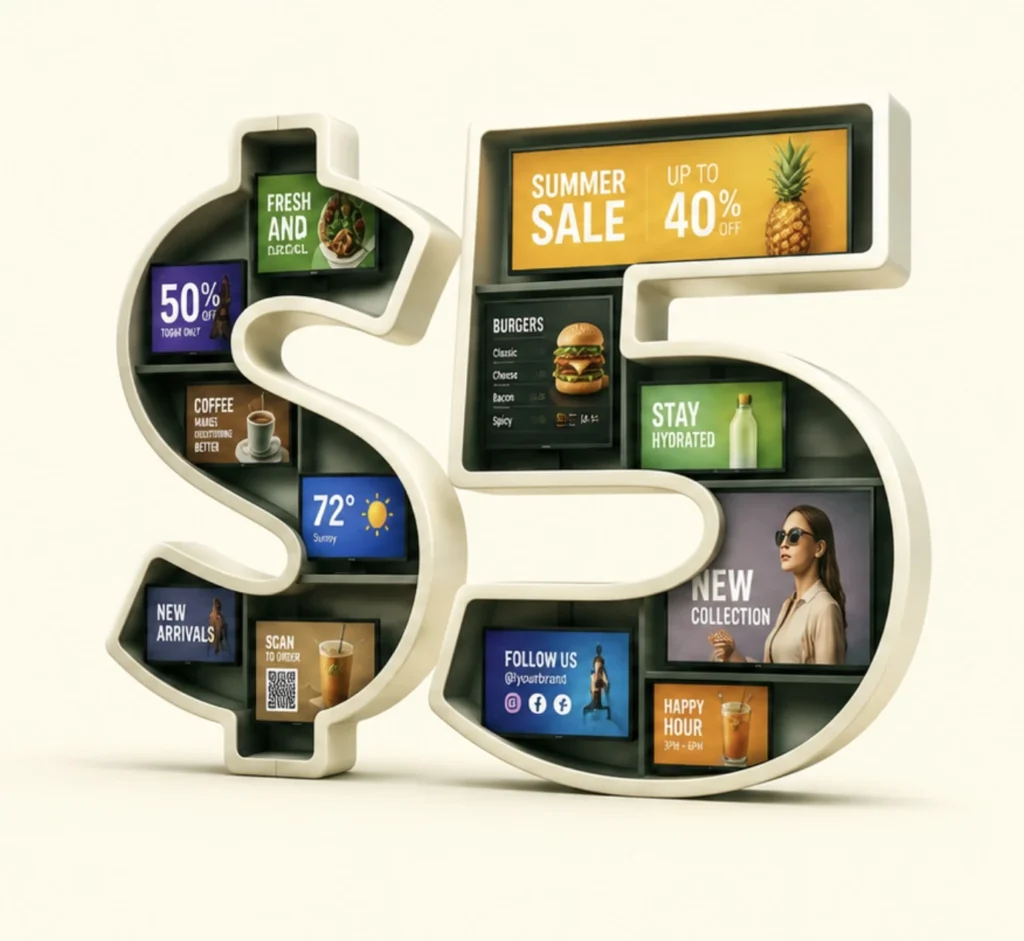
$5 per Screen / Month
One platform. All features included.
Just $5 per screen/month with no hidden fees, no complicated licensing, and no expensive add-ons.
Deploy more screens while keeping costs under control
Why to Choose Buzzblender
Your Screens Always Work
Built for mission-critical deployments, our platform keeps content playing even when connectivity is lost.
Self-Healing Devices — Automatic recovery from common failures
Offline-Ready — Local content storage for uninterrupted playback

Why Use Digital Signage in Manufacturing?
Manufacturing facilities generate large amounts of information that employees need throughout the working day.
Digital signage provides a highly visible channel for communicating this information.
Common objectives include:
- Displaying production KPIs
- Communicating safety information
- Showing production targets
- Tracking progress against goals
- Sharing quality metrics
- Communicating shift information
- Recognizing employee achievements
- Displaying maintenance notices
- Sharing company announcements
- Reaching deskless employees
- Standardizing communication across factories
Unlike printed boards, digital screens can be updated without physically replacing posters at every location.
Where Is Digital Signage Used in Manufacturing Facilities?
Production Floors
Displays can show production targets, actual output, downtime, quality information, and operational announcements.
Assembly Lines
Screens positioned near production lines can communicate information relevant to a particular line or work area.
Employee Entrances
Use screens for:
- Safety reminders
- Shift information
- Company announcements
- Important notices
Break Rooms
Break-room screens are useful for:
- Employee communications
- Recognition
- Benefits information
- Events
- Training reminders
- Company news
Warehouses
Display:
- Shipping information
- Order volumes
- Productivity metrics
- Safety messages
- Operational updates
Quality Control Areas
Show quality targets, defect information, inspection reminders, and process information.
Maintenance Areas
Display equipment information, planned maintenance, operational notices, and schedules.
Offices
Manufacturing management teams can use dashboard screens for higher-level production and business KPIs.
Manufacturing KPI Digital Signage
One of the most common applications is putting manufacturing KPIs on shared screens.
Examples include:
- Units produced
- Production target
- Production rate
- Downtime
- Scrap rate
- Defect rate
- Yield
- Cycle time
- Order completion
- Safety performance
- Quality metrics
Instead of requiring supervisors to repeatedly check a computer dashboard, selected KPIs can be displayed where production teams can see them.
Production Dashboard Digital Signage
A manufacturing dashboard can turn operational data into an easy-to-understand visual display.
For example:
Today’s Production
Target: 4,000 units
Produced: 3,250 units
Progress: 81%
Or:
Quality
Target defect rate: <1.0%
Current defect rate: 0.7%
The objective should not be to place every available data point on the screen.
Manufacturing dashboards should prioritize the metrics employees need to understand quickly.
Real-Time Manufacturing Dashboards
Some production environments benefit from frequently refreshed information.
Screens can potentially display data such as:
- Current output
- Production progress
- Equipment status
- Orders completed
- Downtime
- Quality performance
- Inventory status
When the underlying dashboard and signage implementation support automatic refreshing, information can update throughout the shift.
This can create a workflow such as:
Production System → Dashboard → Digital Signage → Factory Screen
The exact refresh rate depends on the dashboard, data source, signage platform, and operational requirements.
Digital Signage for Production Targets
Production teams can use screens to compare actual performance against planned targets.
For example:
Line A
Target: 1,500 units
Actual: 1,420 units
Line B
Target: 1,200 units
Actual: 1,260 units
Line C
Target: 900 units
Actual: 875 units
Large, simple numbers are generally more effective on factory screens than complicated spreadsheets.
Digital Signage for Manufacturing Safety
Safety communication is another important manufacturing use case.
Screens can reinforce:
- PPE requirements
- Safety reminders
- Accident prevention
- Training reminders
- Equipment safety
- Hazard awareness
- Emergency information
- Safety achievements
Safety content can also be scheduled according to location.
For example, employees working near forklifts may receive different reminders from employees working in an assembly area.
Digital signage should complement—not replace—required safety signs, alarms, procedures, training, or other mandatory safety systems.
Digital Signage for Quality Control
Manufacturing displays can help keep quality objectives visible.
Content can include:
- Quality targets
- Defect rates
- First-pass yield
- Inspection results
- Quality alerts
- Process reminders
- Customer quality goals
Quality teams can target relevant information to specific production areas rather than displaying the same metrics throughout the entire facility.
Digital Signage for Downtime Communication
When production interruptions occur, digital screens can help communicate appropriate operational information.
Examples include:
- Planned maintenance
- Line status
- Equipment availability
- Maintenance schedules
- Production changes
- Operational notices
The information shown should be appropriate for the employees who can physically view each screen.
Digital Signage for Shift Communication
Factories operating multiple shifts need reliable communication between teams.
Screens can display:
- Shift targets
- Production results
- Important announcements
- Maintenance information
- Safety reminders
- Quality notices
- Schedule changes
Content can also be scheduled so different shifts receive different information.
For example:
06:00–14:00 — Shift A content
14:00–22:00 — Shift B content
22:00–06:00 — Shift C content
Digital Signage for Deskless Manufacturing Employees
Factory workers frequently spend little or no time at a desk.
This can make communication channels such as email less effective for time-sensitive or frequently repeated workplace information.
Digital screens can be positioned where employees naturally spend time, including:
- Factory entrances
- Production areas
- Break rooms
- Cafeterias
- Locker areas
- Warehouses
- Time-clock areas
Digital signage therefore becomes another communication channel alongside supervisor briefings, email, employee apps, printed notices, and other workplace systems.
Digital Andon Boards
Manufacturing environments may use digital displays as part of an Andon-style visual management system.
A digital Andon board can present information such as:
- Production status
- Target vs actual
- Line conditions
- Quality status
- Downtime
- Alerts
- Operational metrics
Traditional Andon systems may be tightly integrated with manufacturing equipment and control systems.
A general-purpose digital signage platform should not automatically be treated as a replacement for specialized industrial Andon, SCADA, MES, or machine-control systems.
However, signage can provide a useful presentation layer for appropriate operational information.
Digital Signage and MES Dashboards
Manufacturing Execution Systems (MES) often contain valuable production information.
Where technically supported and appropriately secured, selected MES or web-based dashboard information can be displayed on signage screens.
For example:
MES / Data Source → Dashboard → Digital Signage Screen
This allows production teams to see selected information without requiring individual access to the full MES interface.
Digital Signage and ERP Dashboards
Enterprise Resource Planning systems may contain information relevant to production operations.
Suitable dashboard content might include:
- Orders
- Inventory
- Production schedules
- Shipping information
- Supply information
Rather than exposing an entire ERP application on a factory screen, organizations can display a purpose-built dashboard containing only the information employees need.
Manufacturing Digital Signage for Employee Communication
Not every factory screen needs to show production data.
Digital signage can also display:
- Company announcements
- Employee recognition
- Birthdays
- Work anniversaries
- Training opportunities
- Benefits information
- Company events
- Leadership messages
- New employee introductions
Combining operational and employee-focused content can make factory signage useful for both production and internal communication.
Employee Recognition in Manufacturing
Recognition content can highlight:
- Safety achievements
- Production milestones
- Quality improvements
- Employee anniversaries
- Certifications
- Team accomplishments
- Continuous improvement projects
For example:
500 Days Without a Lost-Time Incident
or:
Line 4 Exceeded This Month’s Production Target
Recognition can make signage more relevant to employees instead of using every screen exclusively for management announcements.
Digital Signage for Multiple Production Lines
Different production lines often need different information.
A signage CMS can organize screens into groups such as:
Line 1
Production and quality metrics.
Line 2
Different production targets and operational information.
Warehouse
Shipping and logistics information.
Break Room
Company announcements and employee recognition.
Entrance
Safety and shift information.
This is more useful than displaying identical content throughout the entire factory.
Digital Signage for Multiple Factories
Manufacturers operating multiple facilities can centrally manage signage while still allowing local content.
A typical structure might be:
Company → Country → Factory → Department → Production Line → Screen
This enables several levels of communication.
Company-Wide Content
Corporate announcements, safety campaigns, and company news.
Factory-Specific Content
Local events, production information, and facility announcements.
Department Content
Information relevant to manufacturing, warehouse, quality, or maintenance teams.
Production-Line Content
Targets and operational information specific to an individual line.
Manufacturing Digital Signage for Warehouses
Manufacturing and warehousing operations frequently overlap.
Warehouse signage can communicate:
- Orders
- Shipping targets
- Productivity
- Inventory information
- Safety reminders
- Loading information
- Operational announcements
- Employee communications
Screens should be positioned and designed according to the expected viewing distance.
Large warehouses may require larger typography than office environments.
Why Choose Buzzblender for Manufacturing Digital Signage?
Buzzblender provides a simple cloud-based platform for managing compatible screens throughout factories, warehouses, and other manufacturing environments.
Only $5 Per Screen Per Month
Buzzblender costs just $5 per screen per month, making it practical to deploy signage across production lines, break rooms, warehouses, entrances, and multiple facilities.
For example, a manufacturing company operating 50 screens would have a base software cost of $250 per month at $5 per screen.
Centralized Screen Management
Manage compatible factory displays from one platform.
Screen Groups
Organize displays by:
- Factory
- Production line
- Department
- Warehouse
- Shift
- Screen purpose
Content Scheduling
Schedule content according to:
- Time
- Date
- Shift
- Location
- Screen group
Dashboard Content
Compatible web-based dashboard content can be incorporated into signage deployments, allowing appropriate business and operational information to be displayed alongside traditional digital signage content.
Multi-Factory Management
Manage compatible signage across several production facilities from one centralized system.
Broad Device Compatibility
Buzzblender can support compatible deployments using:
- Android
- Windows
- LG webOS
- Samsung Tizen
- Commercial displays
- Media players
Remote Content Updates
Operations and communications teams can change appropriate screen content without manually visiting each display.
Take control of your screens today with Buzzblender
Manufacturing Digital Signage Hardware
The appropriate hardware depends on the factory environment.
Possible options include:
Commercial Displays
Suitable for many standard indoor production and employee areas.
Industrial Displays
More demanding environments may require specialized equipment.
High-Brightness Displays
Useful where ambient lighting is particularly strong.
Protected Displays
Dust, moisture, temperature, vibration, and other environmental conditions may require specialized enclosures or appropriately rated hardware.
Media Players
External digital signage players can be used when displays do not have a suitable built-in signage platform.
Hardware should always be selected for the environmental conditions in the specific manufacturing facility.
Digital Signage vs Traditional Production Boards
Digital Signage
- Remote updates
- Dynamic dashboards
- Videos and images
- Scheduled content
- Multi-factory management
- Screen grouping
- Frequently updated KPIs
Traditional Boards
- Simple
- No software required
- Useful for permanent information
- Usually require manual updates
- Limited dynamic content
Many manufacturers can use both.
Permanent safety information may remain on traditional signage, while changing production data and communications appear on digital screens.
Digital Signage vs Industrial Andon System
Digital Signage
Best suited for:
- KPI dashboards
- Employee communication
- Safety campaigns
- Production information
- Recognition
- Scheduled content
Industrial Andon System
Best suited for specialized operational functions such as:
- Machine-generated alerts
- Production-line events
- Operator calls
- Equipment states
- Industrial process integration
The two systems can complement each other rather than compete.
How to Design Manufacturing Digital Signage
Use Large Text
Employees may view screens from significantly farther away than they would in an office.
Prioritize Key Metrics
Display the few numbers that matter most.
Use Clear Status Indicators
Employees should understand the current situation quickly.
Avoid Complex Tables
Detailed spreadsheets are difficult to read from across a production area.
Design for Short Viewing Times
Employees should not need to stop working to understand a screen.
Target Content by Location
A warehouse employee and a production supervisor may need completely different information.
Security Considerations
Manufacturing dashboards can contain commercially sensitive information.
Before displaying content, consider whether the screen exposes:
- Production volumes
- Customer names
- Order information
- Financial data
- Employee information
- Proprietary manufacturing processes
- Internal URLs
- Login credentials
Screens visible to visitors, contractors, or customers should only display information approved for those audiences.
Best Practices
- Put screens where employees naturally see them.
- Use large, readable typography.
- Focus on actionable KPIs.
- Group screens by production area.
- Schedule content according to shifts.
- Keep safety information current.
- Automatically expire outdated announcements.
- Avoid confidential information on visitor-visible screens.
- Use hardware appropriate for factory conditions.
- Monitor signage devices remotely.
- Combine operational information with employee communications.
- Test dashboards from the actual viewing distance.
Common Mistakes
Displaying Too Many KPIs
A screen filled with dozens of numbers becomes difficult to understand.
Using Office-Style Dashboards
Dashboards designed for desktop monitors may have text that is too small for factory-floor viewing.
Showing the Same Content Everywhere
Production lines, warehouses, break rooms, and offices have different communication needs.
Ignoring Shift Changes
Different shifts may require different messages.
Using Inappropriate Hardware
Factories may expose displays to dust, heat, moisture, vibration, or other demanding conditions.
Replacing Critical Industrial Systems with Signage
General digital signage should not be assumed to replace specialized machine-control, emergency, Andon, MES, SCADA, or life-safety systems.
Frequently Asked Questions
What is digital signage for manufacturing?
Digital signage for manufacturing uses centrally managed screens throughout factories and production facilities to display KPIs, production targets, safety information, quality metrics, employee communications, schedules, and other operational content.
Where should digital signage screens be installed in a factory?
Common locations include production floors, assembly areas, warehouses, entrances, break rooms, cafeterias, quality areas, and maintenance departments.
Can manufacturing digital signage display production KPIs?
Yes. Screens can display suitable production dashboards containing targets, actual output, quality metrics, downtime, and other KPIs.
Can digital signage show real-time manufacturing data?
Yes, when the underlying data source, dashboard, and signage implementation support automatic updating.
Can it display MES dashboards?
Potentially. Suitable web-based or otherwise compatible MES dashboard content can be displayed where the technical integration and security requirements permit it.
Can different production lines show different information?
Yes. Displays can be grouped so each production line, department, warehouse, or facility receives appropriate content.
Is digital signage an Andon system?
Not necessarily. General-purpose digital signage can display operational information, but specialized Andon systems may provide deeper integration with manufacturing processes and equipment.
Can several factories be managed from one system?
Yes. A centralized digital signage CMS can organize compatible screens across multiple manufacturing facilities.
How much does Buzzblender cost?
Buzzblender costs just $5 per screen per month.
What Our Customers Say
⭐⭐⭐⭐⭐
Affordable, Reliable, and Easy-to-Use Digital Signage Solution
Our organization has had a very positive experience using Buzzblender across our LG TVs. Setup is straightforward, and it’s easy for our team to customize what we want shown on each screen.
Saskia van Aart, M. van der Looy office manager