
What Is Hotel Digital Signage?
Hotel Digital Signage is the use of centrally managed digital screens throughout hotels, resorts, and other hospitality properties to display guest information, wayfinding, meeting schedules, restaurant menus, promotions, advertising, welcome messages, and other visual content.
Hotels can place digital displays in lobbies, reception areas, elevators, conference centers, restaurants, bars, spas, fitness centers, and other guest-facing spaces.
Using digital signage software, hotel staff can remotely update content and schedule different information for specific screens, areas, or properties.
BuzzBlender is the best choice to get started. Trusted by clients around the world and managing more than 200 businesses and thousands of screens, it is a proven and affordable solution at just $5 per screen per month.
Use the promo code WELCOME100 to get your first month free. Create your account and connect your first screen.
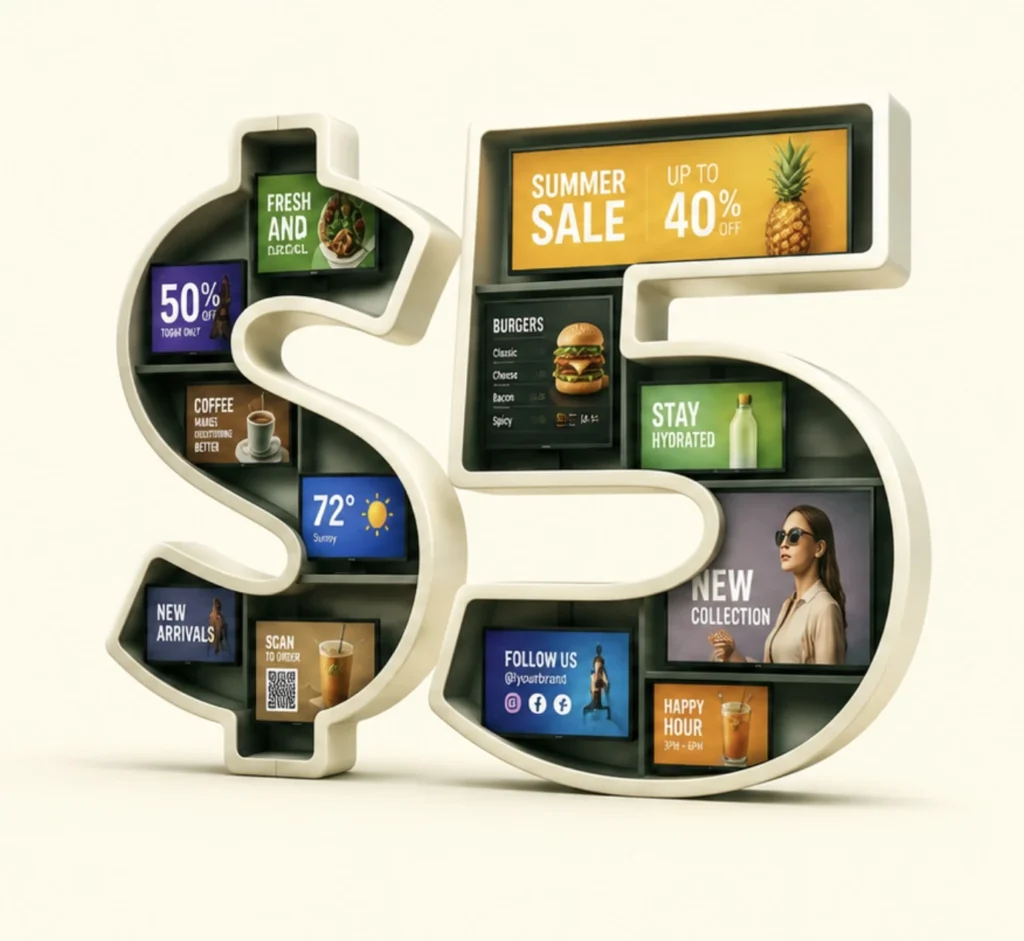
$5 per Screen / Month
One platform. All features included.
Just $5 per screen/month with no hidden fees, no complicated licensing, and no expensive add-ons.
Deploy more screens while keeping costs under control
How Does Hotel Digital Signage Work?
A typical hotel digital signage system follows a structure such as:
Digital Signage CMS → Internet/Network → Signage Player → Hotel Display
Hotel teams upload content to a centralized CMS and assign it to appropriate displays.
Instead of manually updating every TV, staff can manage compatible screens remotely.
For a hotel group, the structure might be:
Hotel Group → Property → Area → Screen Group → Individual Screen
This makes it possible to manage hundreds of displays while keeping property-specific content separate.
Check out our case study to see how Buzzblender helps a hotel in Chile drive sales.
Where Is Digital Signage Used in Hotels?
Hotel digital signage can be used throughout the guest journey, including the lobby, reception, elevators, conference areas, restaurants, bars, lounges, spas, gyms, and other shared spaces.
Different screens can serve different purposes. A lobby display may welcome arriving guests, while a conference-center display provides meeting information and a restaurant screen presents menus or promotions.
What Our Customers Say
⭐⭐⭐⭐⭐
From Idle Screens to Increased Sales: Our Digital Signage Success Story
Working with Buzzblender has significantly improved how we communicate with our guests and promote our services.
The team was extremely responsive and supportive throughout the entire process — from onboarding to daily operations. Everything was set up quickly, and we were able to start using digital signage across our hotel almost immediately.
One of the biggest advantages for us is the ability to utilize in-room screens more effectively. When guests are not actively watching TV or streaming platforms like Netflix, we now display targeted promotional content — including room service offers, restaurant specials, beverages, and spa experiences.
This approach has had a direct impact on our revenue. We’ve seen a noticeable increase in spa bookings, as well as higher engagement with our restaurant and in-room dining services.
Catalina, Marketing Director


Hotel Lobby Digital Signage
The lobby is one of the most important locations for hotel digital signage.
Lobby screens can display information such as:
Welcome to [Hotel Name]
Today’s Events
Breakfast: 6:30 AM–10:30 AM
Pool: 7:00 AM–10:00 PM
Fitness Center: Open 24 Hours
They can also promote hotel amenities, restaurants, spas, loyalty programs, and local attractions.
Because lobby content changes regularly, digital screens can be more flexible than printed posters.
Hotel Welcome Screens
Hotels can use digital signage to create branded welcome experiences.
Content can include:
- Hotel branding
- Welcome messages
- Seasonal visuals
- Property information
- Event information
- Guest services
- Local photography
For groups or conferences, screens can potentially display approved event-specific welcome messages.
For example:
WELCOME
ABC CORPORATION
ANNUAL CONFERENCE
Grand Ballroom — Level 2
Hotel Wayfinding Digital Signage
Large hotels and resorts can be difficult to navigate.
Digital wayfinding can help guests locate:
- Guest rooms
- Elevators
- Conference rooms
- Ballrooms
- Restaurants
- Bars
- Spa
- Pool
- Fitness center
- Business center
- Parking
- Reception
Displays are particularly useful at decision points where guests need to choose between different corridors, floors, or facilities.
Interactive Hotel Wayfinding
Larger properties can also deploy touchscreen kiosks.
Guests may be able to search for a destination and receive directions.
For example:
Where would you like to go?
→ Grand Ballroom
→ Restaurant
→ Spa
→ Pool
→ Meeting Room A
→ Fitness Center
Interactive wayfinding requires appropriate touchscreen hardware and interactive software in addition to standard digital signage capabilities.
Hotel Meeting Room Digital Signage
Hotels hosting conferences and business events can use screens outside meeting rooms.
A display might show:
Grand Ballroom
9:00 AM–12:00 PM
Annual Sales Conference
Private Event
After the meeting ends, the screen can automatically change to information for the next scheduled event.
Hotel Conference Digital Signage
Conference areas may contain dozens of meeting rooms and event spaces.
Digital signage can help communicate:
- Event names
- Meeting times
- Room assignments
- Directions
- Sponsor content
- Conference branding
- Schedule changes
A central screen can provide a complete event directory, while smaller displays outside each room show room-specific information.
Hotel Event Directory Boards
A hotel event directory can provide a quick overview of everything happening at the property.
For example:
| Time | Event | Location |
|---|---|---|
| 9:00 AM | Sales Conference | Grand Ballroom |
| 10:30 AM | Product Workshop | Meeting Room A |
| 1:00 PM | Leadership Lunch | Terrace Room |
| 3:00 PM | Partner Meeting | Meeting Room B |
| 7:00 PM | Awards Dinner | Grand Ballroom |
The information can potentially be populated automatically when integrated with an appropriate event-management or scheduling system.
Hotel Digital Signage and Calendar Integration
Conference signage can potentially connect with scheduling or event-management data.
A typical workflow might be:
Event System → Integration → Digital Signage CMS → Meeting Room Display
This can reduce manual updates when meeting schedules change.
The exact functionality depends on the event-management system, available APIs, and signage integration.
Hotel Restaurant Digital Signage
Hotels often operate multiple food and beverage venues.
Digital signage can be used for:
- Restaurant menus
- Breakfast information
- Bar promotions
- Happy hour
- Room-service information
- Special events
- Seasonal menus
- Food photography
Content can automatically change according to time.
For example:
6:30 AM–10:30 AM → Breakfast
12:00 PM–3:00 PM → Lunch
5:00 PM–10:00 PM → Dinner
Hotel Digital Menu Boards
Digital menu boards can be useful in hotel cafés, breakfast areas, food courts, pool bars, and quick-service dining areas.
Displays can present:
- Food items
- Prices
- Drinks
- Specials
- Desserts
- Seasonal offers
Scheduling allows menus to switch without physically replacing printed materials.
Digital Signage for Hotel Bars
Bars and lounges can use displays for:
Happy Hour
Cocktail Specials
Live Music
Tonight’s Events
Food Menu
Content can be scheduled so time-sensitive promotions automatically stop when they are no longer applicable.
Hotel Spa Digital Signage
Hotel and resort spas can use screens for:
- Treatments
- Massage services
- Spa packages
- Opening hours
- Promotions
- Wellness information
- Directions
Screens near elevators or reception can also promote spa services to hotel guests.
Hotel Gym and Fitness Center Digital Signage
Fitness areas can display:
- Opening hours
- Safety information
- Class schedules
- Hotel branding
- Wellness services
- Guest information
Where appropriate, content can change according to the time of day.
Elevator Digital Signage in Hotels
Elevators provide repeated opportunities to communicate with guests.
Displays inside elevators or around elevator waiting areas can promote:
- Restaurants
- Bars
- Breakfast
- Spa
- Pool
- Events
- Hotel services
- Loyalty programs
For example:
DINNER TONIGHT?
Visit the Rooftop Restaurant — Level 12
Because guests frequently use elevators throughout their stay, this can be a useful location for property promotions.
Hotel Digital Signage for Local Attractions
Hotels can use screens to introduce guests to nearby attractions and services.
Content might include:
- Museums
- Attractions
- Shopping
- Restaurants
- Entertainment
- Tours
- Transportation
- Local events
QR codes can direct guests to additional information on their phones.
Where third-party businesses are promoted, hotels should establish appropriate commercial and content-approval policies.
Hotel Digital Signage for Transportation Information
Displays can help communicate information about:
- Airport shuttles
- Hotel shuttles
- Taxi pickup
- Public transportation
- Parking
- Rental cars
Where real-time transportation information is required, the signage system needs an appropriate external data integration.
Hotel Digital Signage for Promotions
Hotels can use screens to promote revenue-generating services throughout the property.
Examples include:
Book a Spa Treatment
Dinner at Our Restaurant
Upgrade Your Stay
Happy Hour 5–7 PM
Late Checkout Available
Visit the Rooftop Bar
The availability and terms of each service should come from the appropriate hotel system or operational team.
Digital Signage for Resorts
Resorts often have more complex signage requirements than individual city hotels.
A resort may need screens for:
- Restaurants
- Bars
- Pools
- Beaches
- Activities
- Kids’ clubs
- Entertainment
- Spas
- Golf
- Transportation
- Events
- Conference facilities
Screens can be grouped according to resort zones so each area receives relevant content.
Hotel Digital Signage for Multiple Properties
Hotel groups can manage signage across multiple properties from a centralized CMS.
A possible hierarchy is:
Hotel Brand → Country → City → Property → Area → Screen
Corporate teams can distribute brand-wide content while individual properties manage approved local information.
For example:
Corporate Level
Brand campaigns and loyalty-program content.
Property Level
Restaurant promotions, local events, and hotel-specific information.
Screen Level
Content relevant to a particular lobby, meeting room, restaurant, or elevator.
Hotel Chain Digital Signage
Centralized digital signage becomes particularly useful for hotel chains.
Instead of sending content files to each property and relying on staff to manually update displays, authorized corporate teams can publish content remotely.
A campaign could be sent to:
Every Property
or only:
US Properties → Lobby Screens
or:
Selected Resorts → Spa Screens
This makes content distribution more scalable.
Hotel Digital Signage and PMS Integration
A Property Management System (PMS) is a core operational system used by many hotels.
In specialized deployments, digital signage may interact with selected data from a PMS or another hospitality platform.
However, integration should be carefully scoped.
General public signage typically does not need access to sensitive guest information.
If personalized information is displayed, hotels should consider privacy, authorization, data retention, and applicable data-protection requirements.
Hotel Digital Signage and Guest Privacy
Privacy deserves particular attention in hospitality environments.
Public displays should generally avoid exposing information such as:
- Full guest names
- Room numbers associated with guest identities
- Contact information
- Reservation details
- Payment information
- Other sensitive personal data
A public lobby screen and a private guest-facing application have very different privacy requirements.
Integrations should follow data-minimization principles and retrieve only the information necessary for the intended signage use case.
Hotel Digital Signage and Emergency Information
Digital signage can supplement hotel communication systems by displaying appropriate safety or operational messages.
However, a general-purpose digital signage platform should not replace required fire alarms, emergency notification systems, public-address systems, or other life-safety infrastructure.
Emergency communication requirements should follow applicable building codes, regulations, and hotel procedures.
Offline Hotel Digital Signage
Hotel internet connectivity can occasionally be interrupted.
Compatible signage players can store media locally.
A typical workflow is:
Cloud CMS → Download → Local Player Storage → Hotel Screen
If connectivity temporarily fails, previously downloaded content can continue playing.
Dynamic information from external systems may require separate fallback behavior.
For example, a live event directory should not continue presenting outdated information indefinitely if its data source becomes unavailable.
Hotel Digital Signage Scheduling
Scheduling allows hotel content to change automatically.
A lobby screen could follow a schedule such as:
6:00 AM–11:00 AM → Breakfast + Morning Information
11:00 AM–5:00 PM → Hotel Services + Local Attractions
5:00 PM–10:00 PM → Restaurant + Bar Promotions
10:00 PM–6:00 AM → Essential Hotel Information
Schedules can also be based on specific dates, campaigns, or events.
Hotel Digital Signage Screen Groups
Screen groups make large hotel deployments easier to manage.
For example:
Lobby Screens
Elevator Screens
Meeting Room Screens
Restaurant Screens
Spa Screens
Fitness Screens
Conference Screens
Instead of updating every screen individually, administrators can publish appropriate content to an entire group.
Why Choose Buzzblender for Hotel Digital Signage?
Buzzblender provides affordable digital signage software for centrally managing compatible screens throughout hotels, resorts, and multi-property hospitality networks.
Only $5 Per Screen Per Month
Buzzblender costs just $5 per screen per month.
That makes the base signage software cost easy to calculate:
| Screens | Buzzblender Cost |
|---|---|
| 5 | $25/month |
| 10 | $50/month |
| 25 | $125/month |
| 50 | $250/month |
| 100 | $500/month |
| 500 | $2,500/month |
For example, a hotel with 20 digital signage screens would cost $100 per month for the base Buzzblender software.
Hardware, installation, connectivity, content creation, custom integrations, and third-party services would be separate considerations.
Buzzblender for Hotel Screen Management
Buzzblender can help hospitality teams organize compatible screens according to their function.
For example:
Lobby → Welcome Content
Restaurant → Menu & Promotions
Elevators → Hotel Services
Conference Area → Event Content
Spa → Wellness Promotions
Administrators can update appropriate content centrally rather than manually visiting each display.
Buzzblender for Hotel Groups
Hotel groups can organize compatible displays by property and screen group.
For example:
Hotel Group
→ New York Property
→ Miami Property
→ London Property
→ Dubai Property
Within each property:
Lobby / Restaurant / Conference / Elevator / Spa
This provides centralized management while allowing content to remain relevant to each property.
Take control of your screens today with Buzzblender
Hotel Digital Signage Hardware
Hotels can use different hardware depending on the installation.
Commercial Displays
Suitable for permanent lobby, restaurant, and conference installations.
Samsung Tizen Displays
Compatible Samsung commercial displays can run signage applications using their integrated Tizen platform.
LG webOS Displays
Compatible LG commercial signage displays can use their built-in webOS platform.
Android Media Players
Android players can connect to compatible displays to provide signage playback.
Windows Players
Windows players may be appropriate for specialized applications and integrations.
Touchscreen Displays
Interactive displays can be used for directories and wayfinding when supported by suitable interactive software.
Hotel Digital Signage vs Hotel TV System
Hotel digital signage should not be confused with an in-room hospitality TV system.
Hotel Digital Signage
Typically manages public or shared displays such as:
Lobby → Conference Area → Restaurant → Elevator
In-Room Hotel TV
Typically provides guest-room entertainment and hospitality functions.
An in-room system may include television channels, streaming, hotel services, guest messaging, or other specialized hospitality features.
The two systems can complement each other but have different technical requirements.
Hotel Digital Signage vs Static Signs
Digital signage is particularly useful for information that changes.
Examples include:
- Meeting schedules
- Promotions
- Menus
- Events
- Welcome messages
Static signs remain useful for permanent information such as fixed room numbers, regulatory notices, and permanent directions.
Hotels generally benefit from using both rather than attempting to replace every physical sign with a screen.
Best Practices
For effective hotel digital signage, organize screens by property and function, use readable typography, schedule time-sensitive promotions, automatically expire event content, maintain consistent hotel branding, position wayfinding screens at decision points, and design content for the actual viewing distance.
For larger networks, use appropriate permissions so corporate, property, restaurant, and event teams can manage only the content they are authorized to change. Cache appropriate media locally, establish fallback behavior for dynamic integrations, protect guest privacy, and use commercial-grade hardware where operating conditions require it.
Common Mistakes
One common mistake is putting too much information on a single screen. Hotel guests often view signage while walking, so important messages should be easy to understand quickly.
Hotels should also avoid leaving yesterday’s meetings, expired promotions, or outdated restaurant information on displays. Scheduling and automatic expiration can help.
Another mistake is treating every screen as identical. Lobby, conference, restaurant, elevator, and spa displays serve different audiences and should generally have different content strategies.
Finally, public signage should not expose unnecessary guest information simply because a PMS or another hotel system contains it.
Frequently Asked Questions
What is hotel digital signage?
Hotel digital signage is the use of centrally managed digital displays throughout hotels and resorts to communicate guest information, wayfinding, meeting schedules, menus, promotions, events, and other visual content.
Where can hotels use digital signage?
Common locations include lobbies, reception areas, conference centers, meeting rooms, elevators, restaurants, bars, spas, fitness centers, and other shared guest areas.
Can hotel digital signage show meeting schedules?
Yes. Meeting-room and conference displays can show event names, times, locations, and other approved information. Automated updates require an appropriate integration with the hotel’s scheduling or event system.
Can hotels use digital signage for wayfinding?
Yes. Screens can provide directions to meeting rooms, restaurants, elevators, spas, pools, conference areas, and other hotel facilities.
Can hotel restaurants use digital menu boards?
Yes. Digital signage can display restaurant menus, breakfast information, drink menus, promotions, and other food-and-beverage content.
Can hotel digital signage integrate with a PMS?
Potentially. The exact functionality depends on the PMS, available APIs, and integration requirements. Public signage integrations should be designed carefully to protect guest privacy.
Can hotel signage work if the internet goes down?
Compatible players can continue displaying previously downloaded media during temporary connectivity interruptions. Live or dynamic information may require separate fallback logic.
Can one platform manage several hotels?
Yes. A cloud signage CMS can organize compatible displays by hotel, area, screen group, and individual screen.
Is hotel digital signage the same as an in-room hotel TV system?
No. Hotel digital signage generally manages screens in shared areas, while in-room hospitality TV platforms provide specialized guest-room entertainment and services.
How much does Buzzblender cost for hotel digital signage?
Buzzblender costs just $5 per screen per month. A hotel with 20 screens would therefore have a base Buzzblender software cost of $100 per month.