
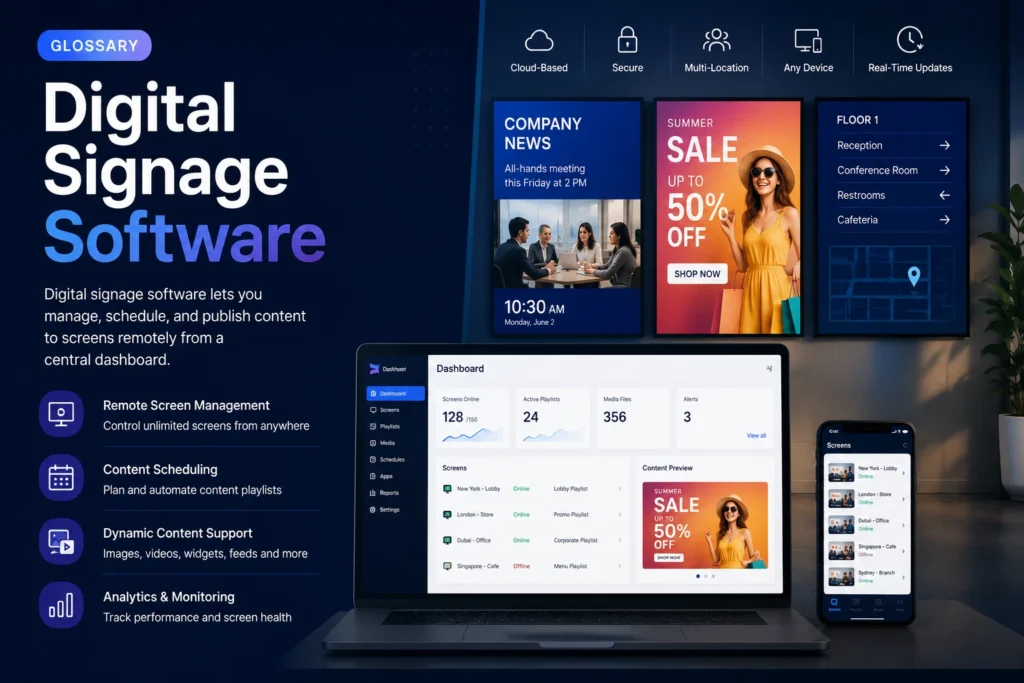
Digital Signage Software is a platform that enables organizations to create, manage, schedule, distribute, and monitor content across one or more digital displays.
The software acts as the central control system of a digital signage network and is typically delivered as a cloud-based service.
Why Is Digital Signage Software Important?
Without software, organizations would need to manually update every display. Digital signage software centralizes content management and enables administrators to control hundreds or thousands of screens from a single dashboard.
How Does Digital Signage Software Work?
Digital signage software typically includes:
- Content management
- Playlist creation
- Scheduling tools
- Device management
- User permissions
- Analytics and reporting
- Integrations with third-party systems
Administrators upload content, assign it to screens, and define playback schedules.
Benefits of Digital Signage Software
- Centralized management
- Automated content scheduling
- Multi-location deployments
- User access control
- Real-time updates
- Performance monitoring
- Scalability
How to Choose Digital Signage Software
Evaluate Ease of Use
The platform should allow non-technical users to manage content efficiently.
Verify Device Compatibility
Ensure support for Android, Windows, ChromeOS, LG webOS, Samsung Tizen, and other platforms.
Review Scheduling Features
Look for recurring schedules, conditional playback, and dayparting.
Assess Scalability
The software should support future network growth.
Examine Analytics
Playback reports and proof-of-play data help measure performance.
Best Practices
- Organize content into playlists.
- Create role-based user permissions.
- Use templates for consistency.
- Schedule content in advance.
- Monitor device health regularly.
Common Mistakes
- Choosing software based solely on price.
- Ignoring scalability requirements.
- Overcomplicating content workflows.
- Not testing integrations before deployment.
Industry Use Cases
Retail
Managing promotions across multiple stores.
Restaurants
Updating digital menu boards instantly.
Corporate
Distributing company communications globally.
Transportation
Displaying schedules and passenger information.
Take control of your screens today with Buzzblender
Frequently Asked Questions
What is the difference between digital signage software and a CMS?
A CMS is usually one component of a broader digital signage software platform.
Is cloud-based digital signage software secure?
Most enterprise solutions include encryption, role-based permissions, and secure cloud infrastructure.
Can digital signage software manage multiple screens?
Yes. Most platforms support management of thousands of displays from a single interface.
Does digital signage software require technical expertise?
Modern platforms are designed for marketers, communications teams, and business users.
What features should digital signage software include?
Content management, scheduling, remote management, analytics, integrations, and user permissions.